
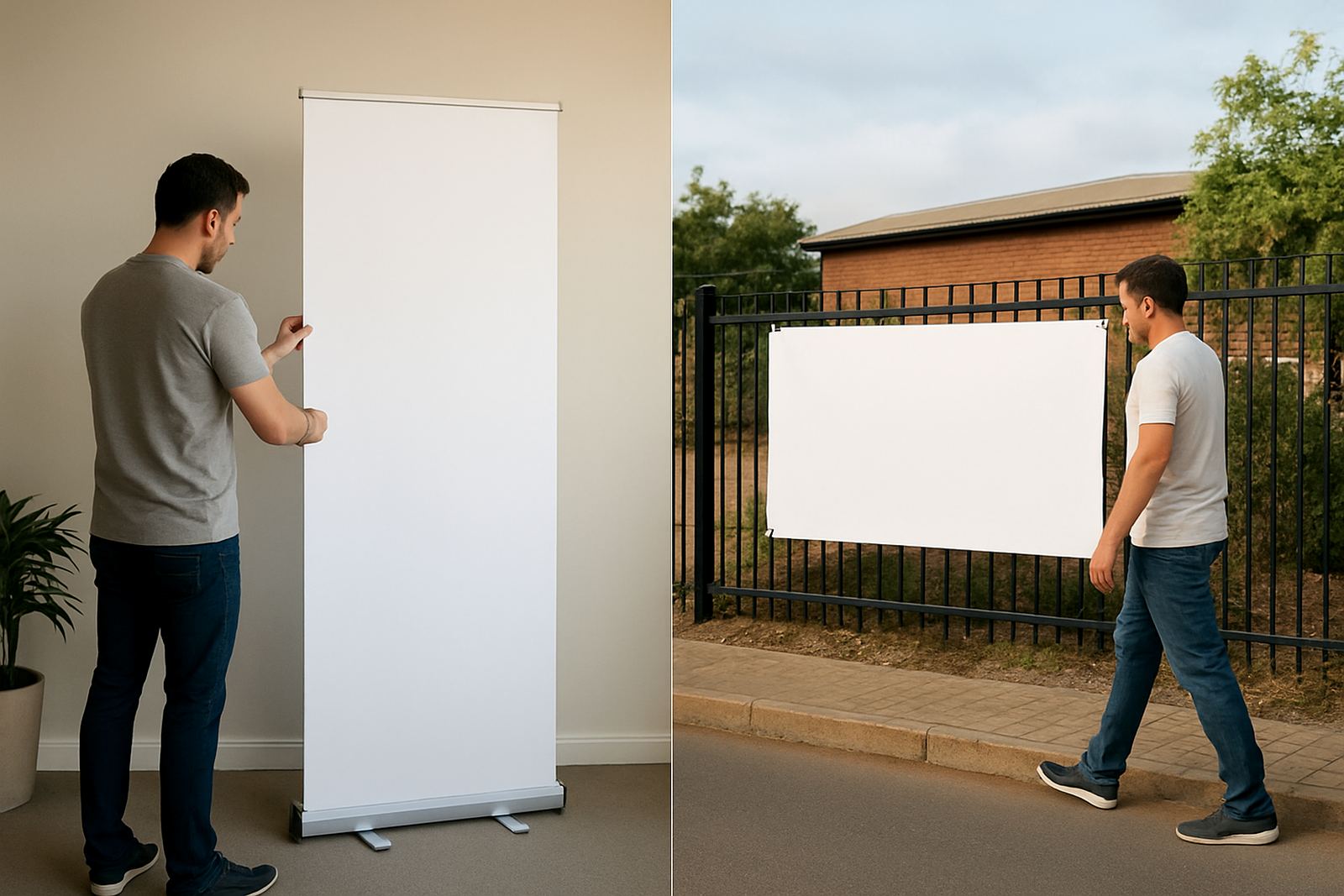
What changes between an indoor banner and an outdoor banner
The biggest difference is how the banner will be used. Indoors, the banner is usually viewed at closer range and in controlled light, so the print can focus on clean detail and sharp colour. Outdoors, the banner has to stand up to wind, sun, dust and the odd summer storm, which means stronger material, better fixing points and a finish that can handle daily exposure.
For West Rand businesses, that choice matters more than most people think. A banner for a showroom in Randfontein CBD is not the same as a fence banner outside a site in Mogale City or a roadside promotion in Roodepoort. If you choose the wrong weight or the wrong edge finishing, the banner can crease, tear or fade much faster than expected. That means replacing it sooner and spending more rand than planned.
Indoor banners are often made for short to medium use. Outdoor banners need more body and more support, especially where wind can catch the corners. The print method also matters, because quick-turnaround digital printing can handle smaller runs, name changes and urgent event work without holding up your promotion.
When an indoor banner is the better fit
Indoor banners suit spaces where people are moving past at close range. Think reception areas, product launches, church halls, school prize givings, training rooms and retail floors. The finish can be lighter because there is no direct rain, and there is less strain on the edges.
These banners are ideal when you need a neat look and quick set-up. They are also useful for repeated events, for example monthly specials or a contractor showing service zones inside a branch. In a Randfontein office, an indoor banner can carry clear pricing, opening hours or a new service message without overpowering the room.
- Best for foyers, halls, indoor promos and counter displays
- Usually lighter in weight and easier to roll up
- Good for close viewing, so text and logos can be smaller
- Works well for short campaigns or repeat events
Indoor banners can still be finished properly with eyelets or pole pockets, depending on how they will hang. If the banner will be moved around a lot, ask for a finish that makes packing and rehanging easier. A neat indoor banner should not curl badly at the bottom or look tired after a few uses, which can happen if the material is too thin.
What outdoor banners need to handle West Rand weather
Outdoor banners need tougher material and stronger finishing because they live in real weather. In Randfontein and surrounding areas, the afternoon wind can lift a poorly fixed banner, while strong sun can fade weak inks and brittle edges. Dust from busy roads and construction sites can also wear a banner down faster.
For outdoor use, the main concern is not only print quality but physical strength. The material should resist tearing, and the fixing points must be placed with care. A banner with only a few eyelets, or eyelets too close to the edge, can start ripping once the wind gets hold of it. If the banner is going onto a fence, wall or scaffolding, the size and tension must be matched to the mounting point.
- Use stronger material for long-term outdoor exposure
- Add enough eyelets so the tension is spread evenly
- Allow for wind movement and secure fixing points
- Choose artwork with high contrast for outdoor viewing distance
Coastal humidity is not the issue in Randfontein, but dust, sun and sudden rain still are. If the banner is for a school sports day in Westonaria or a warehouse opening in Krugersdorp, ask how long it must last and how often it will be moved. That answer shapes the right banner more than the price alone.
Finishing choices that affect how long the banner lasts
Finishing is where a banner either stays neat or starts failing early. The edge treatment, eyelets, hems and pole pockets all make a difference. A banner that will be tied to fencing needs different finishing from a banner that hangs from a frame or a pole.
Hemming strengthens the edges and helps stop fraying. Eyelets make it easier to tie down the banner, but they need correct spacing so the pull is even. Pole pockets are useful where the banner must slide onto a bar or stand. If the wrong finish is used, the banner can crease awkwardly, flap too much or sit crooked. That is not a good look for any business.
- Hems help reinforce edges and reduce wear
- Eyelets spread tension for fence or wall fixing
- Pole pockets suit hanging banners on bars or frames
- Ask about corner reinforcement for windy sites
At @Print in Randfontein CBD, the right finish depends on where the banner will be used and how often it will be taken down. A banner for a one day promotion can be prepared differently from a banner that stays up for months outside a workshop or entrance gate.
Design rules that make a banner readable from the road
A banner can be printed well and still fail if the artwork is too busy. Outdoor banners especially need large lettering, simple layouts and strong contrast. People driving past in Roodepoort or moving through a busy street in Mogale City do not have time to read a full paragraph.
For indoor banners, you can use a bit more detail because viewers stand closer. Even so, clean spacing matters. Keep the message direct and make the main offer or event title the first thing the eye sees. If the banner is for a sale, include the dates and one clear call to action. If it is for a launch, use the business name, what is happening and where to find the stand.
Useful artwork checks before printing:
- Use large fonts for outdoor viewing and smaller detail only indoors
- Keep logos and photos sharp and not stretched
- Check spelling, dates and contact details carefully
- Make sure the message still works from 3 metres and 30 metres
For urgent jobs, a proofing update can save a lot of trouble. A small typo on a banner is expensive to live with because everyone sees it. It is better to sort the wording before production than to remake the banner after installation.
A local example from Randfontein CBD to Roodepoort
Take a West Rand contractor opening a new site office near Randfontein CBD. Inside the office, a lighter banner works well behind the reception table for branding and service information. Outside, at the fence line, the business needs a tougher banner with reinforced eyelets and stronger fixing so it can handle wind and dust through the week.
The same company might also need a second banner for a job in Roodepoort, where the message must be read from the pavement or road. In that case, the artwork should be broader, with fewer words and bolder type. One print job, two different uses, and two different sets of material choices. That is where practical advice saves time and money.
When businesses order the wrong type first, they usually notice it only after installation. The banner sags, the print is hard to read, or the fixing points do not suit the site. Sorting the banner to the location first is the better way round, and it usually gives a cleaner finish too.
How to order the right banner for your site
Start with the location, not just the size. Tell us whether the banner is for indoors or outdoors, how long it must last and where it will be fixed. If it is going to hang in a shop, school hall or along a fence in the West Rand, that detail shapes the material, finishing and layout.
Our Randfontein print shop works with businesses in Krugersdorp, Westonaria, Mogale City and Roodepoort on quick-turnaround digital printing and banner artwork. If you need help with banner design, print ready artwork or a proofing update, it helps to share your text, logo and measurements early so the job can move fast.
- Send the banner size in metres or millimetres
- State where it will be used and how it will be fixed
- Confirm if it is short-term promo work or longer outdoor use
- Share any wording, logo and colour needs before production
With the right brief, the finished banner does what it should: it stands straight, reads clearly and holds up long enough for the job at hand. That is the difference between a banner that works and one that just hangs there looking tired.